Why Roulette Bets Sit Inside or Outside the Layout
Roulette inside and outside bets describe where chips sit on the layout; learn how the sections work, how calls differ and why neither improves your odds.
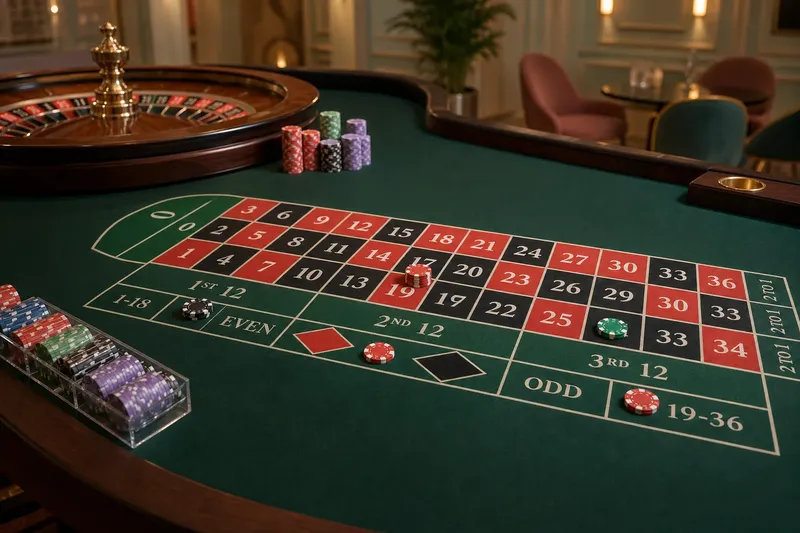
At a roulette table, a player may place a chip on a single number while another sets one across a broad band marked “Red”. Both are roulette bets, but the layout puts them in different zones. Inside and outside describe the positions and groupings printed on the cloth, not a ranking of which wagers are more likely to succeed.
These labels make the betting area easier to read and the dealer’s calls easier to follow. Here are seven useful points for interpreting them without mistaking table geography for an advantage.
1. Read the number grid
The numbered grid is the layout’s inside area. On a standard single-zero table, it shows the numbers from 1 to 36 in three vertical columns, with a separate space for 0. American layouts also include 00. The exact arrangement and markings can vary, so the printed cloth is the working reference.
A chip placed directly on one number is a straight-up bet. Chips may also sit on boundaries or intersections, covering two, three, four or six numbers, depending on their position. These are still called inside bets because they use the number grid and its dividing lines.
Position matters. A chip centred in a numbered square does not mean the same thing as one placed on the line between two squares. If a placement is unclear, ask the dealer before the next spin rather than relying on a hurried guess.
2. Find the outside fields
Outside bets occupy the marked spaces around the number grid. Common options include red or black, odd or even, low or high, and the dozen or column groups. These wagers cover sets of numbers rather than a single numbered square.
“Outside” is a location term, not a claim that the wager sits beyond the roulette wheel or apart from the game. It means the bet is placed in one of the layout’s broader fields outside the central number grid. Some tables print these fields in a band below the numbers; others use side panels.
The zero or zeros matter when reading these groups. In ordinary roulette layouts, zero is not red or black, odd or even, nor part of the low or high ranges. It is shown separately on the cloth, and its treatment in a particular wager follows the game’s rules.
3. Separate position from coverage
Inside and outside classify where a wager is placed, while the wager itself determines which outcomes it covers. A bet on a dozen is an outside bet covering a group; a bet on two neighbouring numbers is an inside bet covering a small group. The zone does not tell you how many outcomes are included.
That distinction helps explain why table talk sometimes sounds more complicated than the actual placement. “Split” refers to a wager on two adjacent numbers, not to a separate section of the table. “Street” refers to a row of three numbers, while “corner” covers four numbers that meet at a point.
Think of the layout as a map: the zone gives the address, and the wager type gives the territory covered.
4. Track the chip position
Roulette chips are often colour-coded by player at a live table, so the dealer can distinguish one player’s wager from another’s. The casino’s value for those coloured chips is specific to that table; they are not necessarily interchangeable with ordinary cash-value chips elsewhere.
A dealer may place a chip on a number, line or outside field with a clear, deliberate motion. If you are placing a bet yourself, use the designated area and avoid covering markings or another player’s stack. At a busy table, hand the dealer the chips and state the intended wager if you are unsure where they belong.
Say you want to cover the first dozen but cannot see whether its box begins beneath the first or second row. Point to the printed field and ask the dealer to confirm it before betting closes. The expected result is a clearly placed wager that both you and the dealer can identify, not a change in its probability.
5. Read the dealer’s calls
Dealers use short names for common bets because the layout’s markings are familiar to regular players. “Red” or “odd” identifies an outside field; “straight up on 17” identifies a single number in the grid. A call such as “split 8 and 11” refers to the boundary between those squares.
The terminology helps communicate the placement, but it does not replace checking the table. A spoken call can be misheard in a noisy room, and a chip can be moved or obscured. If the dealer repeats or confirms your wager, listen for the location and the numbers or group named.
For a new player, one clear wager is easier to verify than several chips scattered across the layout.
6. Keep odds separate
Inside bets usually cover fewer possible landing numbers than broad outside bets. That makes them less likely to win on a given spin, while their payouts are typically larger when they do. Outside bets cover more numbers and generally pay less. Those are differences in coverage and payout, not evidence that one zone offers better odds.
In a given roulette version, the wheel and the house rules determine the chance of each outcome. A red bet does not become more favourable because its box is wide, and a single-number wager does not become more favourable because it pays more. The payout reflects the number of outcomes covered and the game’s built-in advantage.
Roulette spins are independent. A result on the previous spin does not alter the layout’s categories or make a particular number due on the next one. Choose a wager, if you choose to play, with the understanding that its label describes its placement and coverage, not a forecast.
7. Check the table version
Roulette layouts differ by wheel and house rules. A single-zero European-style table and an American-style table with both 0 and 00 do not have identical number spaces. Rules for certain outside bets when a zero appears may also differ; the felt and the table’s stated rules are the relevant guides.
Some tables offer additional wagers or use slightly different labels. “Low” and “high”, for example, refer to defined number ranges, while dozens and columns have their own marked spaces. Do not assume a familiar name covers precisely the same set of outcomes on every table.
Where the correct interpretation depends on the printed layout or house rules, check those before placing a wager. If gambling is causing financial or personal difficulty, consider speaking with a qualified support service in your area.
Questions players ask?
Are outside bets safer?
They cover more numbered outcomes than many inside bets, so they may win more often in a simple comparison of wager coverage. That does not make them safer or better value: payouts and the wheel’s rules also matter, and losses remain possible.
Is a dozen bet inside or outside?
A dozen is an outside bet because its marked field sits beyond the number grid. It covers the numbers in one of the layout’s dozen groups, rather than a single square or a boundary between squares.
Does the zero count as red or black?
No. Zero, and double zero where present, is shown separately and does not belong to the usual red-and-black groups. How a zero affects a particular wager depends on the table’s rules.
Can I place chips on a line?
Yes, marked boundaries are used for bets such as splits, streets and corners. The precise position determines which numbers are covered, so ask the dealer to confirm a placement that is difficult to distinguish.
When you look at a roulette layout, start by identifying the number grid and the fields around it. That simple distinction explains the language of roulette inside and outside bets, while leaving the actual choice of wager where it belongs: with your understanding of coverage, rules and risk.