Faro Card Play History and the Rise of the Banking Table
Faro card play history shows how a rank-based banking game worked at public tables, while separating documented procedures from uncertain claims about its origins.
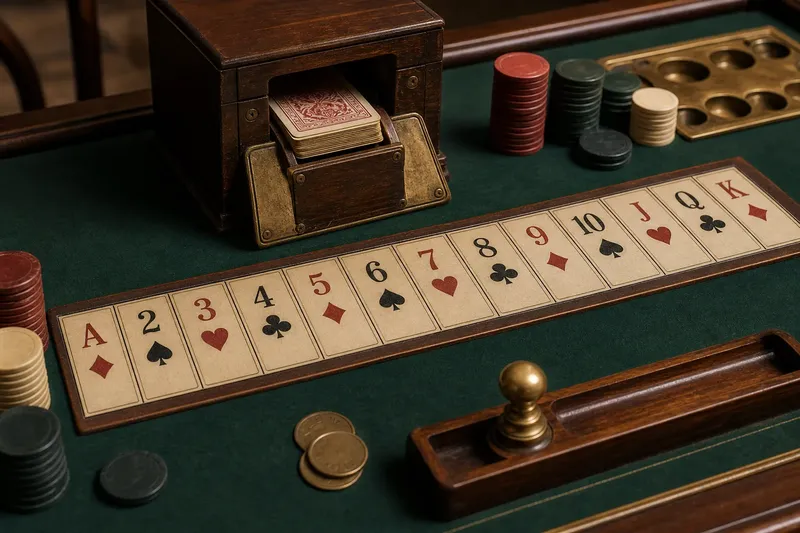
A faro layout placed rank cards in view while a banker dealt from a box and players put wagers on the table. Faro card play history concerns not only a pack of cards, but also the public arrangements that made this banking game recognisable.
Cards in Europe
Playing cards were established in Europe by the late medieval period, although accounts of how they arrived differ. The surviving record supports a broad history of changing production and use; it does not justify a simple story in which one invention immediately carried cards into every household.
Cards served for amusement in homes, inns and courtly gatherings. Wagers were one possible use, and rules or restrictions on gaming varied by place and period. A portable pack could be used in different settings without making every game, or every gathering, a gambling occasion.
That portability made card play adaptable. A group might play privately, while a public banking game required a recognised dealer, a place for stakes and a procedure for settling them.
Faro’s European record
Faro, also called pharaon or faro bank, was associated with France before it spread elsewhere in Europe and across the Atlantic. Historical accounts connect it with basset, an earlier French banking game, but the relationship should not be treated as a settled, direct line of descent.
Claims about Faro’s origins and transmission need careful handling. Contemporary descriptions and surviving rulebooks can show how the game was played in a particular time or place; they cannot, on their own, establish every stage in its development or spread.
Players wagered on ranks shown on a layout. The banker exposed cards in sequence and settled wagers under the rules in use. Players did not hold hands or make a long sequence of decisions; the visible deal gave the table its rhythm.
In the United States, Faro became associated with nineteenth-century saloons and the West, but the saloon image is not a complete account of its settings. It also appeared in other commercial gaming rooms. Any claim about its precise reach should be tied to evidence for a particular place and period.
The banker’s table
A public venue changed more than a game’s address. A private group might settle wagers informally; a commercial table needed a recognisable banker, a clear place for stakes and procedures that players could follow.
Faro’s equipment made those roles visible. Rank cards showed what players could back, the dealing box marked the source of the cards, and the banker’s position identified who controlled the deal and settlement. These objects helped organise the process; they were not mere decoration.
Say an invented group begins with one pack, a hand-written rank layout and house rules, then moves its game from a parlour to a licensed gaming room. The venue assigns one banker, displays the layout where players can see it and records stakes under its own procedures. The observable result is a clearer public routine, while the group’s rank-based wagers remain the game’s central feature.
Decline and comparison
Faro lost prominence as other games gained ground, but the broad shift does not establish a single cause. Explanations based on its equipment, accounting or changing tastes require evidence tied to particular venues and periods. It is safer to distinguish the game’s procedures from claims about why people moved on.
Faro’s decline did not end card gaming. Blackjack centres on a player’s hand against a dealer’s, while baccarat organises play around competing hands and a banker’s procedure. These comparisons clarify different table arrangements; they do not show that either game directly replaced Faro everywhere.
For a historical comparison, ask who handles the cards, how wagers are placed or recorded, and whether players compete with one another or take part in a house-run process. Those details reveal how a game was organised in a particular venue.
Questions about Faro?
What was a faro bank?
Faro bank was another name for the banking game, and the banker dealt and settled wagers. Players backed ranks displayed on the layout rather than competing by holding hands.
Was Faro only played in saloons?
No. Faro is strongly associated with American saloons, but it also appeared in other commercial gaming rooms and social settings. Its setting depended on local circumstances and the people running the game.
Why did Faro lose popularity?
Faro’s prominence declined as gaming tastes and commercial venues changed, but a single explanation needs reliable historical support. Describe the shift without assigning it confidently to one feature of the game.
Did Faro’s decline end card gaming?
No. Other card games continued with distinct rules and table procedures. Faro’s history concerns one game’s changing place in gambling culture, not the end of card play.
Reading the evidence
Museum material, historical rulebooks and accounts of gambling venues can help establish how Faro was played and represented. Read each source according to its purpose: a rulebook may explain procedure, while a later cultural account may emphasise the saloon image or the game’s reputation.
- Observe whether a source gives a date and place; if both are clear, use it for claims about that setting, but if either is missing, keep the claim broad.
- Observe whether a rulebook describes a particular procedure; if it does, use it to explain that version of play, but do not treat it as proof of the game’s full origin.
- Observe whether a source is contemporary with the events it describes; if it is, assess it as evidence from that period, but if it is later, identify it as a retrospective account.
- Observe whether an account distinguishes Faro from basset; if it does, preserve that distinction, but if it merges them, avoid presenting a direct descent as settled fact.
- Observe whether a description names a saloon or another venue; if it does, limit the claim to that setting, but if it does not, avoid assigning the game a specific location.
- Observe whether a source explains the banker, layout and dealing box; if it does, use those details to describe table procedure, but if it does not, do not infer the missing arrangement.
Faro card play history is clearest when procedure, setting and historical claims remain distinct. The banker, layout and venue rules show how a familiar pack could serve a public table, while careful source reading keeps the game’s uncertain origins in proportion.