The Dealer Button Is a Marker, Not a Dealer
The dealer button in poker marks positional order, not the person dealing. Learn how it sets the blinds, action order and table rotation at a glance.
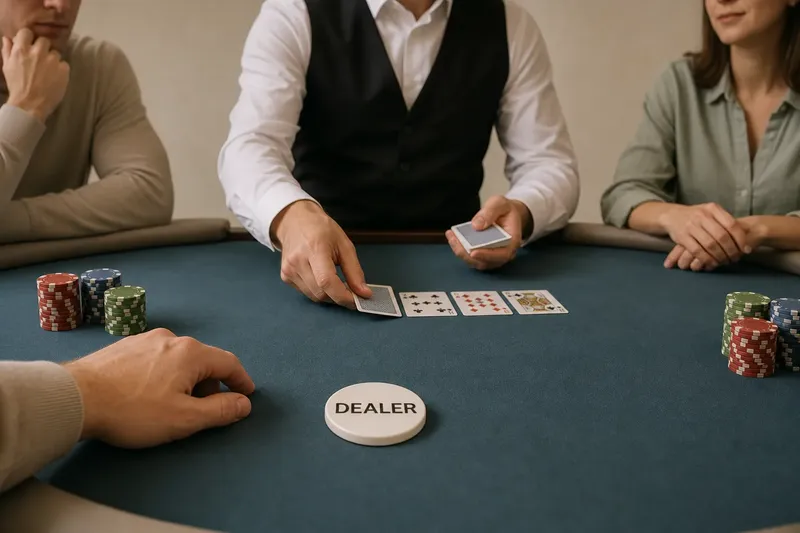
A round disc sits in front of one player while a casino employee deals the cards. The dealer button in poker marks that player’s position; it does not identify who handles the deck. Keeping those jobs separate makes the order of a hand easier to follow.
Two separate roles
The dealer button, often shortened to “the button”, marks the nominal dealer position for a hand. Poker uses that position to set the order of the blinds and action, regardless of who physically deals.
In a casino, a house dealer usually shuffles and distributes the cards, manages the pot and announces the action. The button stays in front of a player, often as a disc marked “DEALER”. It does not make that player an employee or give them authority over the game.
In a home game, players may deal in turn, or one person may deal every hand. The button still marks the same position; the person handling the cards may be the button player, another player or a designated dealer.
Treat the button as a map pin, not a job title.
Blind and action order
In common flop games such as Texas hold’em and Omaha, the small blind is posted by the first player clockwise from the button: the player immediately to its left when viewed from the table. The big blind is posted by the next player clockwise after the small blind, usually the following seat. So the order is button, small blind, big blind.
Before the flop, action starts with the first active player clockwise after the big blind. After the flop, action starts with the first active player clockwise after the button. If that player has folded or is otherwise out of the hand, action begins with the next active player in the same direction.
This gives the button a later position after the flop. A player who remains in the hand generally acts after the others, which allows them to see what opponents do before choosing an action. Position is useful, but it does not strengthen the cards or settle the hand.
The house dealer manages the cards; the button anchors the positional order.
Different dealing arrangements
Casino-dealt games
A casino dealer handles the cards while the button marks one player’s position. To follow the hand, locate the button and track the action around the table rather than inferring the order from the dealer’s station.
Player-dealt games
In a home game, players may pass the deck around as they take turns dealing. The button may identify the person due to deal, or it may serve only as the positional marker. Agree which arrangement applies before play, so dealing the cards is not mistaken for posting a blind or acting first.
Fixed dealer
A home game may keep one person at the deck while the button moves from player to player. The marker advances because the positions and blinds must rotate; the dealer need not move with it.
Whatever the arrangement, keep the button’s rotation distinct from the dealing job.
Common button questions?
Who is the dealer button?
The player with the button occupies the nominal dealer position for that hand. In a casino, that player usually does not physically deal; in a home game, they may or may not handle the cards.
Who acts first after the flop?
In common hold’em and Omaha games, the first active player clockwise after the button acts first. If that player has folded, action starts with the next active player in the same direction.
When does the button move?
In a standard game, it advances one seat clockwise after each hand. This moves the blind positions and post-flop order around the table, subject to the room’s procedure if a player leaves or a seat is added.
Does every button mark the dealer position?
No. Some games use other markers for special positions or actions, and a format may use more than one disc. Check the table’s rules or ask the dealer what each marker means before acting.
Choosing a table convention
For a home game, choose an arrangement that makes the button easy to see and its direction of travel easy to remember. If one person deals every hand, let the button continue clockwise while the dealer stays in place. If players take turns, agree whether the deck and button pass together.
Say Sam has the button, with Riley in the next seat clockwise. Riley deals the cards, and the other players agree that the small blind sits immediately after the button and the big blind follows that player. They place those blinds accordingly; before the flop, the first active player after the big blind begins, while after the flop action starts with the first active player after Sam. The result is a clear order even though Riley, not Sam, handled the deck.
When you join an unfamiliar table, find the button first. Trace clockwise to identify the small blind and then the big blind; for the action, remember that pre-flop play begins after the big blind and post-flop play begins after the button. If the marker or local procedure is unclear, ask the dealer before acting.
The dealer button in poker is a compact reference for position, not a claim about who dealt the hand. Once you separate those meanings, the marker is easy to read: note who has it, follow the agreed direction, and let the cards provide the drama.